
Medicine Bow Wind Farm
Date Published
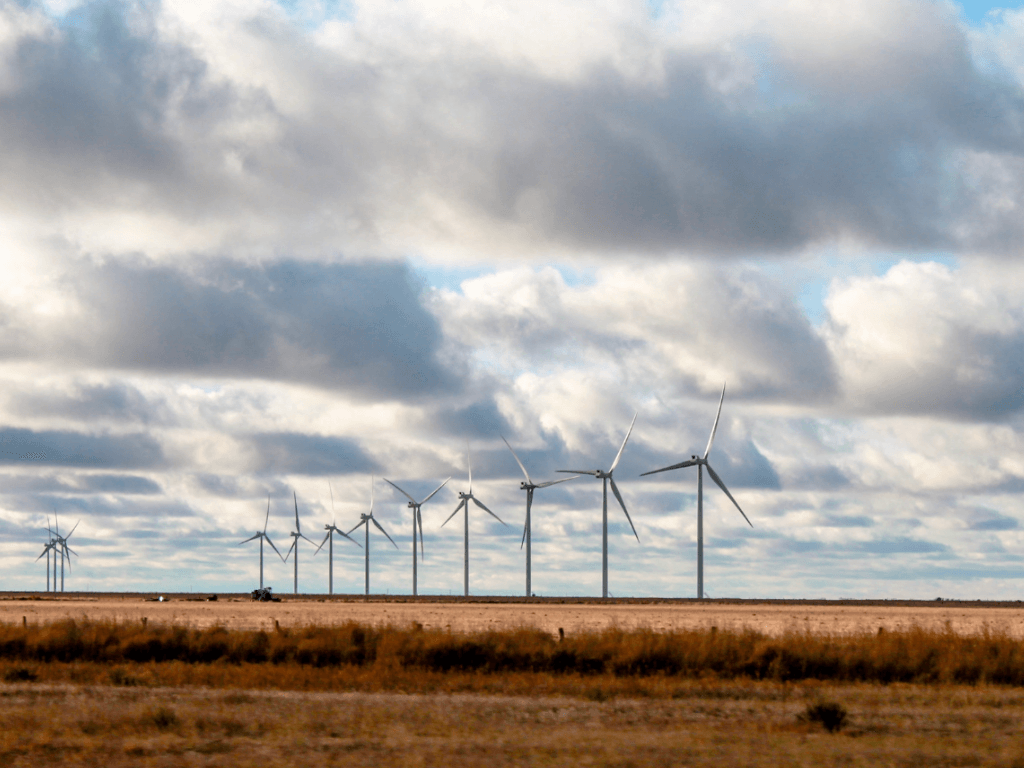
A Legacy That Continues Powering the Future
Medicine Bow Wind Farm in Carbon County, Wyoming, has long played a unique role in U.S. wind energy history.
From pioneering experiments in the 1980s to decades of operation and careful decommissioning, the project demonstrates how thoughtful planning and infrastructure stewardship can leave a lasting impact — both for the community and for the broader renewable energy industry.
The history of Medicine Bow shows that the true legacy of an energy project lies not only in the power it generates, but in how it is managed from beginning to end.
Pioneering Wind Energy Experiments at Medicine Bow
Medicine Bow was one of several early Department of Energy-backed test sites, but it distinguished itself by generating some of the most extensive operational data of the era. Insights from the site informed turbine design standards and maintenance protocols across the U.S., helping commercial wind power move from concept to scalable reality.
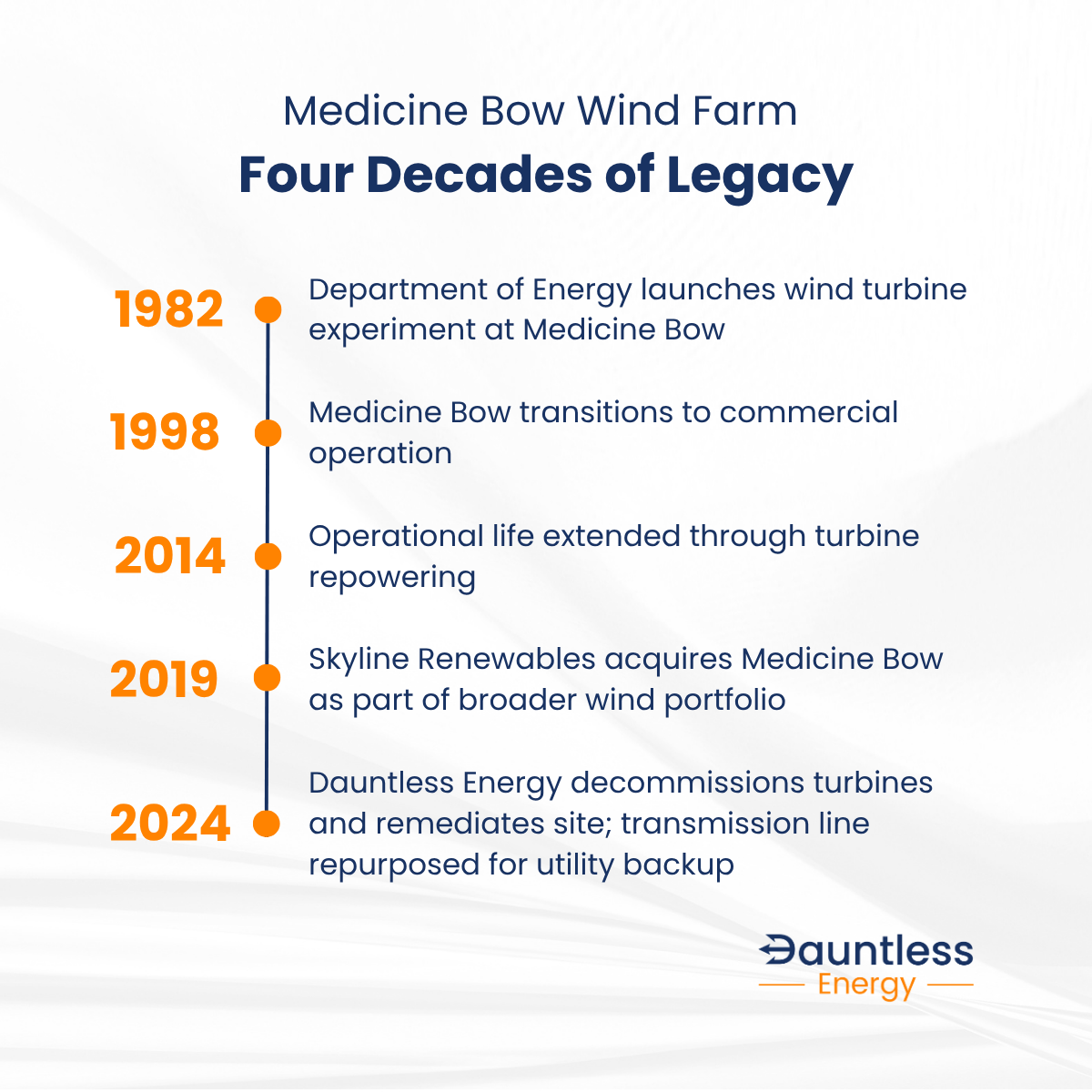
When the Department of Energy launched its wind turbine experiment at Medicine Bow Wind Farm in 1982, commercial wind power barely existed in the U.S. The site became one of the country’s first large-scale proving grounds, hosting initial turbine prototypes that would help shape decades of future wind projects.
The site featured two experimental turbines: Boeing’s MOD‑2, which operated intermittently for about eighteen months before a main bearing failure, and Hamilton Standard’s WTS‑4, which ran until 1986 before a mechanical fault ended its operation. While neither achieved continuous commercial-scale output, both generated critical insights into turbine design, materials performance, and maintenance. Wyoming’s high winds, cold winters, and remote terrain pushed the technology harder than any lab could, revealing what commercial-scale turbines would need to survive.
Medicine Bow became a proving ground — a place where trial, error, and adaptation laid the foundation for the next generation of wind farms.
Managing Legacy Assets: Lessons from Medicine Bow’s Lifecycle
After its experimental chapter, Medicine Bow entered commercial operation in 1998. The project ran for more than a decade before being repowered in 2014 with nine Vestas turbines, totaling about 6 MW of capacity. The upgrade extended its life, even as larger and more efficient technologies were becoming the industry standard. The repowering allowed the project to continue generating power efficiently, extracting additional value from legacy infrastructure without the environmental or capital cost of a completely new site.
Skyline Renewables added Medicine Bow to its portfolio in 2019, recognizing both its legacy and remaining potential. That portfolio is now managed by Dauntless Energy, who has carried forward the same rigor and long-term perspective while guiding the site through its closeout.
Medicine Bow’s long lifecycle — from DOE test site, to commercial operation, to decommissioned and remediated asset — underscores how innovation in energy is rarely a single leap forward. Instead, it is built through early failures, incremental improvements, and adaptive repowering.
The project embodies a simple but powerful philosophy held by the Dauntless team: real craft lies in stewarding an asset thoughtfully, from beginning to end. “Even after turbines stop spinning, the site continues to deliver value,” says Dauntless CEO Todd Wynn. “Value for the community, for the grid, and for our portfolio. That’s the essence of thoughtful asset management.”
Repurposing Transmission Lines: A Sustainable Win-Win
By 2024, Medicine Bow had reached the end of its wind generation life. The turbines were dismantled and recycled, and the site was remediated with care.
But the project’s story didn’t end there. Working with the local utility, Dauntless ensured the site’s existing transmission line would continue to serve the community — this time as a backup pathway to strengthen the regional grid.
Instead of requiring the utility to build a new transmission path or having the line sit idle, the existing infrastructure was repurposed for a nominal fee. This approach avoided additional environmental disturbance, reduced project costs, and provided the utility with immediate redundancy — a practical, sustainable solution. What once carried power from pioneering turbines now creates ongoing value for households and businesses.
Dauntless’ oversight of the Medicine Bow project embodies the full arc of asset management. From acquisition through repowering to retirement, each stage was navigated with intention. Guided by principles of thoughtful wind farm lifecycle management, the site continued to deliver value long after its turbines stopped turning.
Medicine Bow’s Takeaways for Portfolio Strategy
Lessons from Medicine Bow inform a broader philosophy of long-term asset stewardship. Decisions made at every stage — whether repowering, reusing, or retiring infrastructure — can shape the legacy an asset leaves behind.
Most notably:
Repowering is selective. Not every site should be extended. Careful evaluation ensures capital is placed where it creates the greatest long-term benefit.
Infrastructure has second lives. Transmission lines and other systems can outlast generation, providing resilience and redundancy when thoughtfully repurposed.
Closing well matters. The way an asset is retired reflects the priorities of its owner and its responsibility to the community.
For Dauntless, these principles guide evaluation across the portfolio, informing decisions on where to invest, what to extend, and how to exit in ways that preserve long-term value.
After all, progress isn’t only measured in megawatts installed. It’s also found in how projects are stewarded to the very end.
Sources
U.S. Bureau of Reclamation: The Medicine Bow Wind Energy Project
Wyoming News: Medicine Bow Wind Farm Gets 21st Century Upgrades